
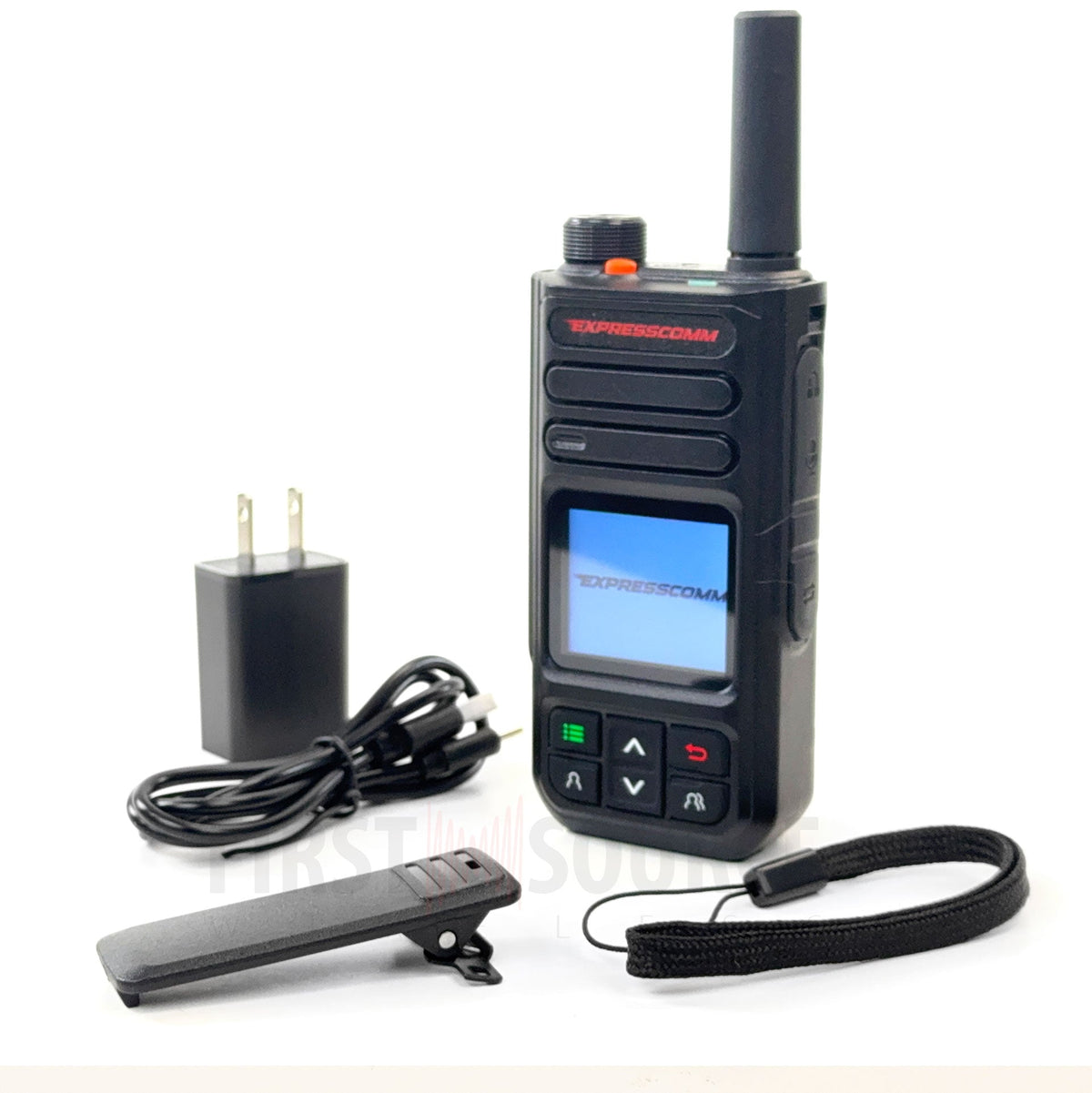
An unlimited range walkie talkie can connect people across cities and states using cellular networks. Instead of relying on a direct radio signal between handsets, it carries voice through a cellular push-to-talk service.
“Unlimited range” describes freedom from the distance limits of a direct radio connection. It does not mean guaranteed coverage everywhere. Each radio still needs supported service at its location.
For businesses coordinating employees across properties, service areas, or job sites, these radios offer a simple way to reach a group with one press of a button.
Explore XpressComm nationwide LTE walkie talkies and request a team quote.
How do unlimited range walkie talkies work?
These devices use a technology called Push-to-Talk over Cellular, commonly shortened to PoC.
When you press the talk button, the radio sends your voice through its cellular connection to the push-to-talk platform. The service delivers that audio to other connected radios in your assigned group.
You may also hear these devices called:
- Nationwide walkie talkies
- LTE walkie talkies
- Cellular walkie talkies
- LTE two-way radios
The basic experience is familiar: press the button, speak, and release it so another person can respond. The difference is how the voice travels between users.
A conventional radio system’s reach depends on factors such as antennas, terrain, buildings, and repeater infrastructure. A cellular walkie talkie uses supported cellular coverage to connect users across a much wider operating area.
What does “unlimited range” actually mean?
With a direct radio connection, the handsets must be within reach of each other or the radio system supporting them.
With a cellular connection, the distance between handsets is no longer the main restriction. Two employees could communicate from separate states if both devices have supported coverage, active service, and the correct group configuration.
However, an LTE radio cannot create a cellular connection where none exists.
Think of range and coverage as two separate questions:
| Question | What matters |
|---|---|
| How far apart can users be? | The service’s supported operating area |
| Will a radio work at a particular location? | Supported cellular coverage and local conditions |
| Can two employees hear each other? | Connectivity, active service, and group configuration |
| Will it work during an outage? | Whether supported networks remain available |
For more about interstate communication, read how XpressComm LTE radios connect teams across states.
Where do cellular walkie talkies work?
Cellular walkie talkies work where their service can establish a usable connection to a supported network.
Before purchasing, check the places your employees actually work. That includes:
- Indoor offices, warehouses, and maintenance areas
- Customer properties and construction sites
- Regular driving routes
- Rural locations and outlying facilities
- Areas with previously reported reception problems
An outdoor coverage estimate does not establish reception in every room of a building. Testing radios at your working locations is a useful part of planning a fleet.
A phone receiving service nearby can provide an initial clue, but it does not guarantee identical radio performance. Devices can differ in their antennas, supported bands, and network access.
How does automatic network switching help?
XpressComm uses a multi-carrier SIM supporting the three major US cellular networks.
When the current connection becomes unavailable, the radio can automatically switch to another supported network where service is accessible. This gives employees more flexibility as they move through areas with different network coverage.
For example, one supported network may provide a usable connection at a property where another has weak reception.
Automatic switching depends on an alternative supported connection being available. It does not eliminate dead zones or guarantee communication during widespread outages or severe congestion.
What do unlimited range walkie talkies cost?
Compare the total cost of equipping your team, including:
- Radio purchases: The equipment needed for each employee.
- Service: The cellular push-to-talk service required for each device.
- Accessories: Compatible earpieces, headsets, spare batteries, or other equipment your team needs.
For XpressComm nationwide service, the first year is included with the radio purchase. After the included first year, nationwide renewal costs $65 per radio annually.
| Fleet size | Annual nationwide renewal after the first year |
|---|---|
| 2 radios | $130 |
| 5 radios | $325 |
| 10 radios | $650 |
| 20 radios | $1,300 |
These totals cover service renewals. Equipment purchases and optional accessories are additional.
A useful comparison is the total cost over your planned ownership period. Include the equipment purchase, renewals after the included service period, and accessories.
View current XpressComm equipment pricing and coverage options.
How can businesses use XpressComm?
XpressComm supports group communication for up to 200 users, along with private one-to-one calls.
That lets businesses organize communication around their work:
- Property management: Reach maintenance staff assigned to different properties.
- Security companies: Connect supervisors and employees across separate sites.
- Construction and field services: Coordinate crews working on multiple projects.
- Hospitality: Communicate between properties and operational teams.
- Transportation and towing: Connect dispatch staff and drivers throughout covered service areas.
The benefit is a dedicated way to reach the appropriate team without calling employees individually.
You can also expand your fleet later. First Source Wireless can program additional XpressComm radios to join your existing communication groups before shipment at no additional charge.
What should you know about batteries and accessories?
XpressComm features an 8800mAh removable battery, USB-C charging, and more than five days of standby time.
Standby time measures the radio waiting for communication. Frequent transmitting and receiving reduce runtime, so plan charging around actual use. A removable battery also gives you the option to keep a charged spare available.
The Kenwood K-type accessory connection supports compatible wired earpieces and headsets. An earpiece can help employees hear messages discreetly while working around customers or guests.
Is an unlimited range walkie talkie right for your team?
An LTE walkie talkie is worth considering when employees need frequent push-to-talk communication across locations with supported cellular coverage.
Before ordering, identify:
- Where the radios will be used
- How many employees need them
- Which users should share communication groups
- What accessories each role requires
- The equipment and ongoing service budget
If your team routinely works without cellular coverage, the cellular connection will not meet that requirement. Assess coverage before choosing the system.
Connect your team with XpressComm
XpressComm brings group and private push-to-talk communication to employees working across buildings, cities, and states wherever supported service is available.
First Source Wireless can help you plan your fleet, configure communication groups, and choose compatible accessories.
Shop XpressComm nationwide LTE walkie talkies, or select “Request a Bulk Quote” on the product page to discuss your team’s needs.